math
AI
physics
Why Navier-Stokes Actually Matters
OpenAI says an AI system proved a fluid equation can break down in finite time. Here's the actual Navier-Stokes problem, precisely.
OpenAI said an AI system solved a math problem that’s stood open since 1934.
The internet reacted before it understood the claim.
Three camps formed immediately.
- Camp one: AI just did real science. A milestone. OpenAI’s CEO, Sam Altman, can be happy.
- Camp two: not so fast. 10k agents grinding through trial and error isn’t insight. That’s brute force.
- Camp three: just confused. How does anything blow up to infinity, in finite time, when the force behind it stays finite the whole time?
Here’s the actual problem. Nobody agrees on what’s being claimed.
That’s the story. Not who’s right about AI.
The Fight, Formalized
Picture a fluid mid-negotiation.

Push it one way. It wants to keep going that way. It concentrates. It twists. It speeds up wherever it’s already fast. That’s inertia.
Something pushes back. Viscosity. It smooths the motion out. It trades concentrated energy for calm, spread-out flow.
Whatever velocity the fluid has right now is wherever that fight currently stands.
A referee sits between them: pressure. It doesn’t take sides. It has one job: keep the fluid from piling up anywhere. Whatever flows in has to flow back out. Pressure adjusts instantly to enforce that.
That’s the whole equation:
is the outcome. is inertia’s move. is viscosity’s countermove. is the referee. is the rule it enforces. is anything pushing from outside. Usually nothing. Sometimes not.
Sometimes the fight settles. Nothing accelerates. Every term cancels. That’s a steady flow, the kind in a textbook diagram of pipe flow.
The Clay Mathematics Institute put this fight on its list of seven Millennium Prize Problems: does a solution stay smooth forever, or does it eventually break?
Can the fight ever fail completely? Can inertia beat viscosity so badly the outcome stops being a finite number?
How Strict “Smooth” Actually Is
“Smooth” undersells it.
Mathematician Charles Fefferman wrote Clay’s official problem statement. It asks the initial velocity to decay faster than any power of distance. In every spatial derivative:
Velocity here is a disturbance that fades out far from it. Every rate of change of it also fades out.
That’s Schwartz-function behavior: an idealized, perfectly localized disturbance.
The force gets the same treatment but in space and in time:
The official problem has 4 statements. Statements (A) and (B) skip force entirely. They just set . Statements (C) and (D) allow a real force, but only one this disciplined.
No pumping in extra energy. No infinity smuggled in through the forcing term.
That’s what “the force stays finite” actually means, made precise.
Say a solution fails. It hits some finite time . Past that point it can’t stay smooth and finite-energy. Fefferman is explicit about what that looks like:
The velocity blows up as . Not the pressure. Not a stray derivative.
That’s also why nobody can simulate their way to an answer. A number climbing to proves nothing. It could still turn around. What’s needed is a proof: one specific, well-behaved that inevitably blows up, no matter how far the clock runs. Ten thousand agents can’t shortcut that by volume.
Why Three Dimensions Break the Truce
Two-dimensional fluids can’t do something three-dimensional ones can: stretch their own rotation.
Picture a spinning tube of fluid. Pull it thinner and longer. Like a figure skater pulling in their arms, it has to spin faster.
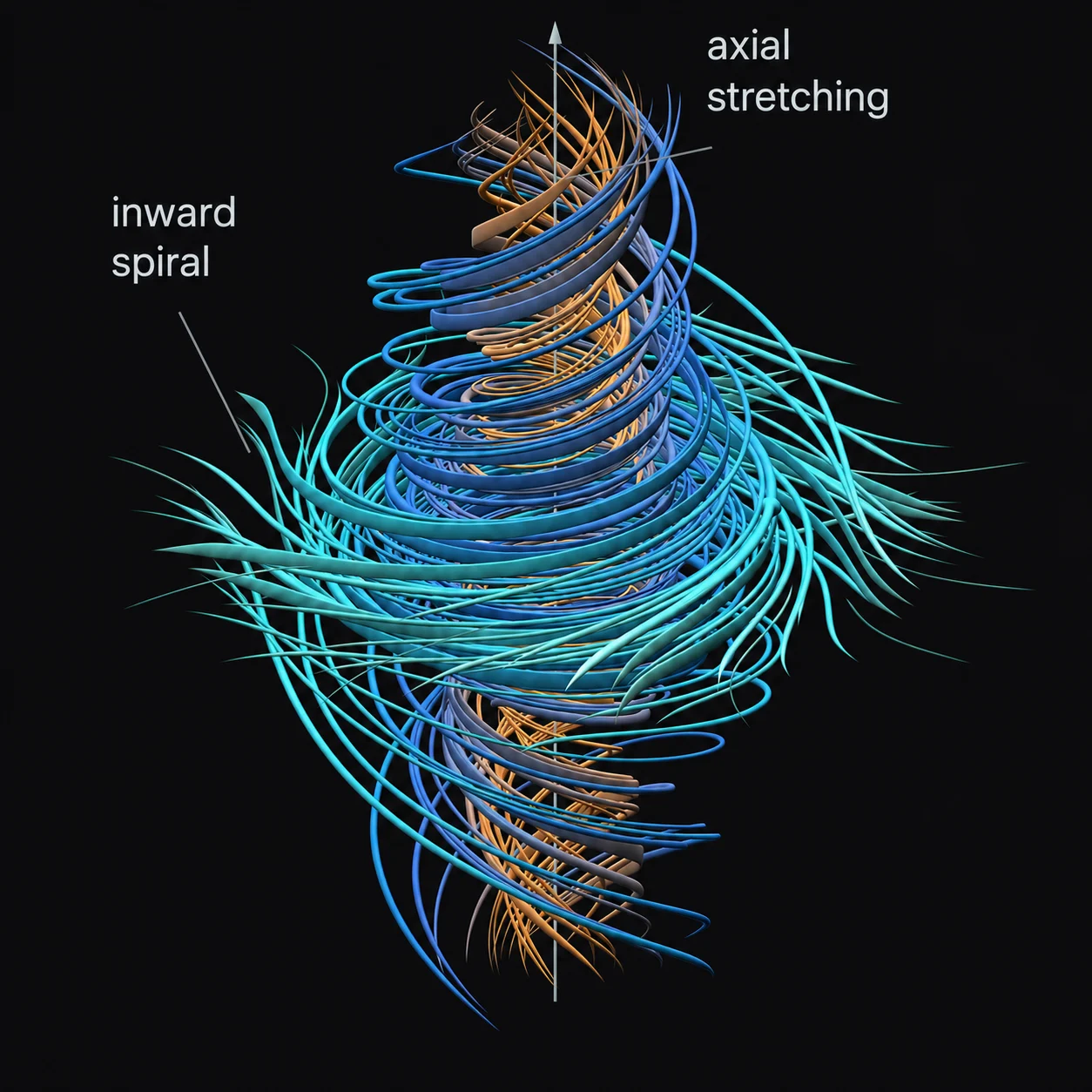
3D flow can twist and pull on itself this way. 2D can’t. There’s no third direction to stretch into.
That one geometric difference is most of the story. 2D regularity was settled decades ago. 3D is still open.
That’s the feedback loop in one frame. Fluid spirals inward. Stretches along the axis. Stretching speeds up the rotation. The orange region tightens as it goes.
Let that loop run away completely, within finite time, instead of leveling off as viscosity catches up. Velocity concentrates into an ever-shrinking region. Fast enough to diverge.
That “ever-shrinking region” solves a puzzle.
The problem still requires finite total energy: stays bounded.
That sounds like it should rule out infinite velocity anywhere. It doesn’t.
An integral measures the total, not the peak. shoots to infinity as , but its square is still integrable near zero.

A 3D blow-up could work the same way. Infinite at one point. The energy spread over all of space stays completely ordinary.
But don’t relax yet. Viscosity isn’t a fixed wall waiting to stop the fluid. It scales with how fast things are already moving. The harder inertia pushes, the harder viscosity pushes back.
So the loophole isn’t free. Every step the vortex takes toward collapsing, its own opponent gets stronger too. Whether inertia can still win that race, in finite time, against a defense that reacts to the attack, is the actual open question. Not a technicality. Not a footnote. The whole problem, restated.
Where It Actually Stands
Here’s what’s settled. OpenAI released a full write-up, and a formalization in Lean, a proof assistant that checks each logical step by machine, that anyone can run.
Here’s what isn’t. Whether the math community, working through it independently, agrees it’s correct.
Clay’s own page still lists Navier–Stokes as open. OpenAI isn’t claiming the prize.
Computed and formalized isn’t peer-reviewed. Peer-reviewed isn’t accepted. This sits on the first rung.
What OpenAI built, and who deserves credit, is next.
Ok. What Now?
Strip away the letters. Look at what’s underneath.
A model. Written in 1822. Patched in 1845. Two hundred years old.
It assumes fluid is continuous. No molecules. No grain. Just numbers, smoothly varying, forever.
Nobody has ever seen that fluid. It doesn’t exist. It’s a convenience that happens to work shockingly well.
(A) through (D) test the convenience, not the water. Whether the idealization can be pushed into a contradiction on its own terms.
Win or lose, no faucet cares.
All models are wrong. Some are useful. Navier–Stokes has been the second kind for two centuries running. This fight is about whether it’s also, quietly, the first kind — and always was.
For mathematicians, that question is the whole point.
For Sam Altman, it was never the question. It was a valuation event.
Read also in Spanish and Portuguese.